Is the future of AI in fitness building a real-time fitness coach?

by
Joris Blaak
on

AI is everywhere and you have probably noticed. It is in your inbox, in your software, in your search results and increasingly in the products you use every day. The conversation around AI can sometimes feel repetitive, but the technology itself is anything but limited. We are still discovering what becomes possible when AI is combined with real-world data, hardware and human interaction.
We regularly take on research and innovation projects that allow us to explore what technology could do beyond what is already possible today. Sometimes that means investigating a new technology. Sometimes it means testing an idea that is not yet ready for a product. And sometimes, it means asking a simple question: what happens if we combine the things we already know with something completely new?
A Dutch-German collaboration focused on Industry 4.0
At MoveLab, we strive to apply for subsidies to support research, learning and experimentation. Our approach to every subsidy is therefore practical: how does this fit within our organization, our expertise and our ambitions, and how can we use the opportunity to actually move something forward? We use these projects as a framework for exploring ideas that can ultimately strengthen our products, our knowledge and the solutions we build for the fitness industry.
Our latest project, developed together with NOHRD, gives us the opportunity to do exactly that. The project is supported through KPF INDUSTR_I4.0, a subsidy programme focused on innovation and collaboration across the Dutch-German border. The project brings together MoveLab's expertise in connected fitness software with NOHRD's expertise in fitness hardware, design and manufacturing. The cross-border aspect is an important part of the project: combining Dutch software and technology expertise with German hardware engineering creates an opportunity to develop something neither partner could build as effectively on its own.
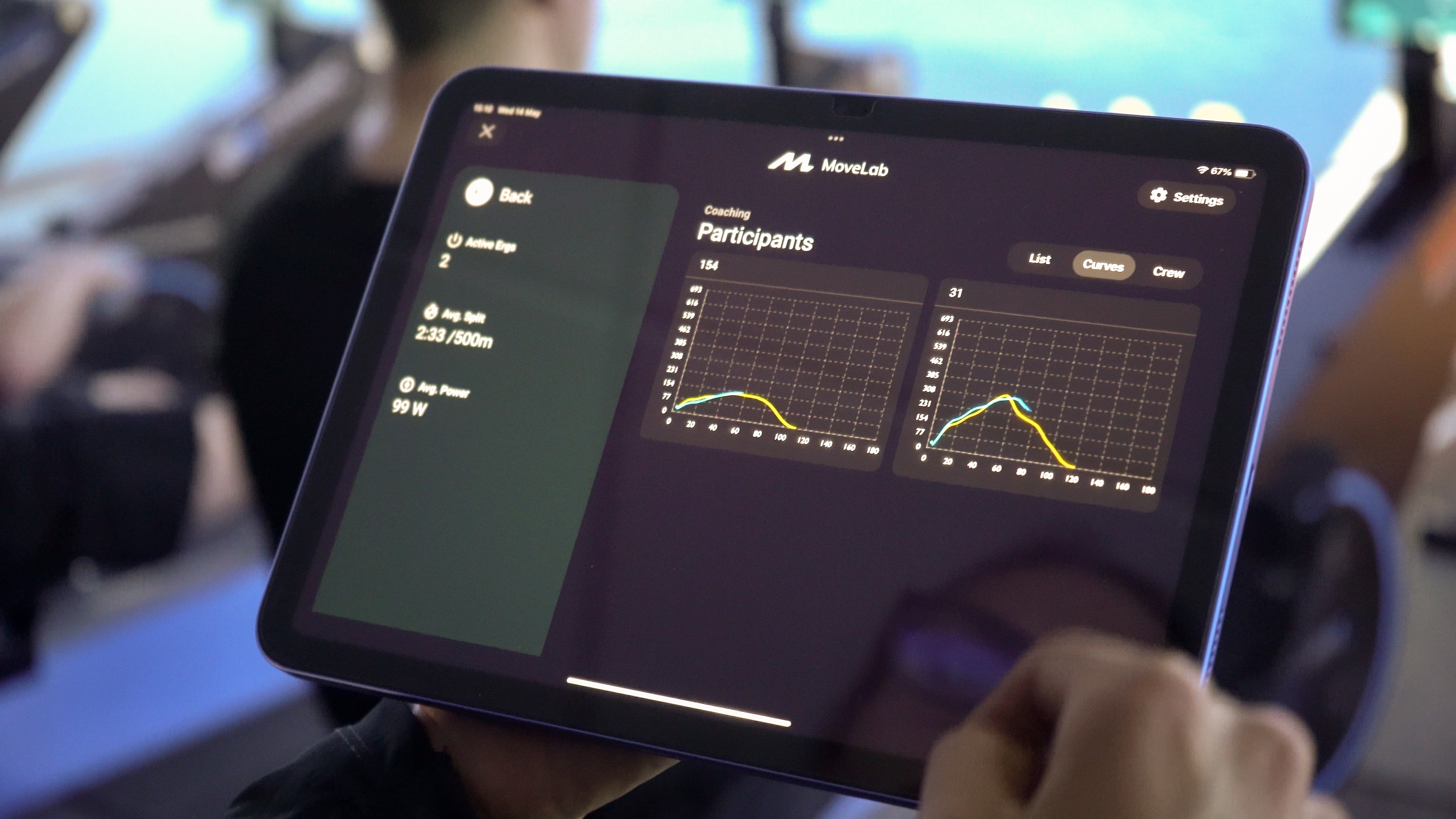
Our project is called AI-driven fitnesscoach. ****The goal is to explore and develop a prototype AI fitness coach that can support users in a personal, real-time and adaptive way.
Moving beyond a static training plan
Many digital fitness experiences still follow a relatively linear model: a plan is created, a workout is completed, and the results are used to inform what comes next.
Our ambition is to explore what happens when this becomes a continuous feedback loop. Instead of simply following a predefined programme, the AI fitness coach can respond to what is happening before, during and after a workout. This means looking beyond whether an exercise was completed and exploring how the training experience can adapt to the individual over time. A user’s progress, performance and input can all contribute to making the next session more relevant.
The goal is not to replace the trainer. It is to explore how technology can provide more responsive tools and better information to support both trainers and users. AI can already generate a training plan, the more interesting question is what happens when it can also respond to the workout itself.
Building AI into the equipment itself
Another important part of the project is that we are not simply developing an AI application that sits separately from the fitness equipment. The ambition is to connect the intelligence with the equipment and the training environment. The project explores technologies including on-device AI, vector databases and pose detection, integrated into the software that connects the user with the equipment. On-device processing is particularly interesting because it can reduce reliance on a constant cloud connection, while supporting fast response times and stronger control over data. For a real-time training experience, latency matters. If a system is going to respond during an exercise, a delayed response is not particularly useful. The technology therefore needs to be designed around the reality of a gym, studio or home environment, rather than a purely digital one.
The part of AI that is less visible
There is another side to developing AI in fitness that is just as important as the technology itself: making sure it is safe and responsible. A system that influences someone's physical training cannot simply generate an answer and call it a day. The project therefore includes research into data privacy, security and the regulatory requirements surrounding AI and personal data. The project plan specifically considers the EU AI Act and GDPR, alongside principles such as data minimization, transparency and human oversight.
This is also one of the reasons why research projects like this are valuable to us.
We are not only asking, "Can we build it?"
We are also asking:
Should we build it this way?
What data do we actually need?
How can the user remain in control?
How do we make the system understandable and reliable?
These questions need to be part of the development process from the beginning, not added once the technology is already finished.
Curiosity is part of the job
The fitness industry is changing quickly. Connected equipment, sensors, apps, data and AI are creating possibilities that were difficult to imagine only a few years ago. But we do not think innovation is about adding technology simply because it is new. It is about finding useful ways to apply it. That is why projects like this matter to MoveLab. The subsidy gives us the opportunity to dedicate time and resources to research that might otherwise compete with day-to-day product development. Working with NOHRD adds another perspective, combining software and hardware expertise across the Dutch-German border. And ultimately, that is what we want to get out of these projects: more knowledge, better technology and a clearer understanding of what connected fitness can become.